
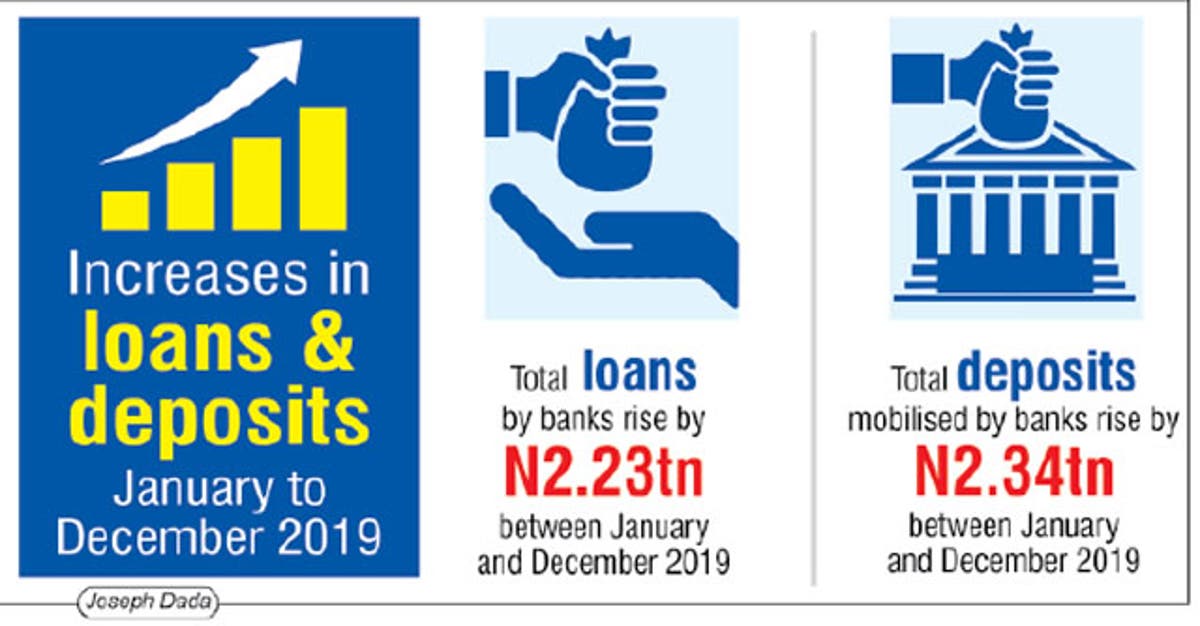
The total
loans by Deposit Money Banks to the economy rose by N2.23tn between
January and December 2019, data obtained from members of the Monetary
Policy Committee of the Central Bank of Nigeria have revealed.
Also,
during the period, the total deposits mobilised by banks from their
customers rose by N2.34tn according to figures released by members of
the MPC.
The
figures were contained in the personal statements made by the MPC
members during the last Monetary Policy Committee meeting held at the
headquarters of the CBN on January 24.
The personnel statements were released on Wednesday by the Central Bank of Nigeria.
Members of
the committee in their personal statements also put the Non-Performing
Loan Portfolio of the banking industry at 6.1 per cent as at December
2019.
The NPL portfolio of 6.1 per cent in December represented a decline from the 11.3 per cent which it was in February, 2019.
The CBN
Deputy Governor, Financial System Stability, Aisha Ahmad, in her
personal statement said the financial system would emerge stronger in
2020, even as credit to the private sector continued to grow.
She said,
“Capital adequacy, liquidity and other prudential ratios remain within
desired levels, whilst the NPLs ratio in particular, reduced further to
6.1 per cent as at end December 2019, from 6.6 per cent at end-October
2019.”
The key
challenge for the apex bank, according to her, would be to sustain this
positive industry risk profile, notwithstanding continued growth in
credit driven by the Loan to Deposit Ratio policy.
In his
personal statement, another MPC member, Obadan Idiah, said the financial
sector had continued to show good performance as portrayed by various
financial soundness indicators.
He said
the NPL has maintained its downward trend, standing at 6.1 per cent in
December, 2019 compared to 11.3 per cent in February, 2019.
Idiah said the liquidity ratio stood at 45.6 per cent last December compared to the minimum requirement of 30 per cent.
He said
the capital adequacy ratio of 14.5 per cent was good in relation to the
prudential requirement of 10 per cent to 15 per cent.
These rates, he noted, were higher than those of comparator countries such as Turkey, South Africa and Malaysia.
He said,
“The structure of total assets has also changed in favour of more loans
and advances, and less of government securities. It shows that the
impact of the loans to deposit ratio policy has been positive.
“The
growth in total deposits has also been steady; total deposits recorded
an increase of N2.34tn or 10.73 per cent between December 2018 and
December 2019.
“Besides,
aggregate credit growth has also been impressive; total credit increased
by N2.23tn or by 14.54 per cent between December 2018 and December
2019.”
He said the growth in credit was largely due to the apex bank’s policy on LDR.
Some of
the sectors that got the credit were manufacturing N446.44bn; general
retail and consumer loans N419.02bn; general commerce N248.48bn;
agriculture, forestry and fishing N160.94bn; information and
communications N156.47bn.
Others were finance and insurance N129.87bn; construction N86.54bn; and transportation and storage N68.61bn.
Tags
Finance