

(CNN) - The
streets of Ecuador's western city of Guayaquil are deserted, with few
residents in sight -- and a few dead, as bodies are being left in the
streets of this overwhelmed place.
The coronavirus pandemic
is overloading the public services in the country's most populous city
to a point of collapse. Hospitals have no beds left to accept sick
patients, and morgues, cemeteries and funeral homes are straining. With
no place left to put them, some residents say they have no choice but
placing them outside.
It's
unclear how many of the deceased are dying because of Covid-19. Many
families say their loved ones had symptoms of the virus, while others
only know the ill were unable to be treated at Guayaquil's overwhelmed
hospitals.
"We
have been waiting for five days," Fernando Espana said in a video
obtained by Reuters on March 30, as he complained about the struggles to
have authorities come pick up his family member.
"We
are tired of calling 911 and the only thing they tell us is to wait,
they are working to solve this," he continues as he moves the camera
through a window to show a black plastic-wrapped shape inside the home,
with two fans blowing on it.
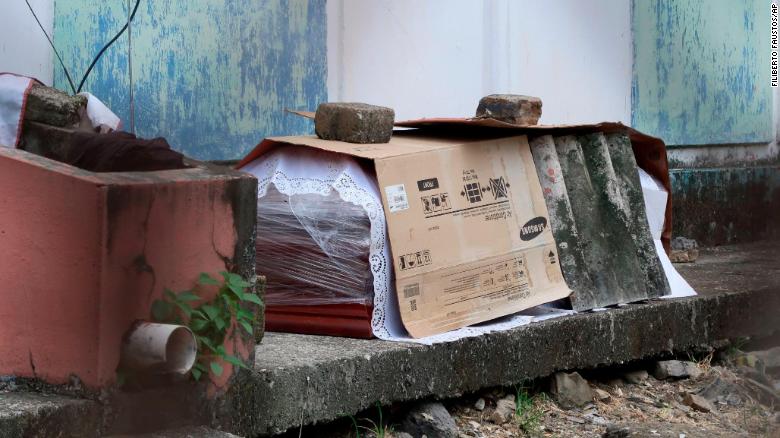
A
coffin containing the body of a person who is supposed to have died
from Covid-19 lays wrapped in plastic and covered with cardboard,
outside a block of family apartments in Guayaquil on April 2.
The
smell is too much to take. "It's the odor from the body that one can no
longer handle," Espana's neighbor, Glenda Larrea Vera says in the same
video, from across the street and behind a mask. "And we also have
neighbors that are elderly. I have my mother who is 80 who is also
having respiratory problems."
Video
surveillance from last week obtained by CNN shows a motorcyclist
abandon a body in the street. Hours later, a group of people, dressed in
special hazmat suits are seen picking up the deceased, then driving off
in a vehicle.

In
another video obtained by CNN, a group of people remove a body from a
car. Covered in face masks, they wrap the body in a what appears to be a
black tarp when a police vehicle approaches minutes later. A
conversation takes place and the group puts the body back into the car.
Police tell CNN they could not offer details about the video.
National
figures show that Ecuador's authorities have collected more than 300
bodies from private homes in the city -- which has 2.99 million
residents, according to the CIA Factbook -- between March 23-30.
The
city is on the Guayas River and is the nation's major port.
Brittanica.com calls it the country's most economically important city.
Jorge
Wated, head of a joint military task force created to deal with
Ecuador's coronavirus crisis, in a televised interview on Wednesday said
that his task force had gone from "taking away 30 deceased per day to
150" over the past three days. Wated added that this was "independent of
the hard work reactivated by the private funeral homes and graveyards
in the country."
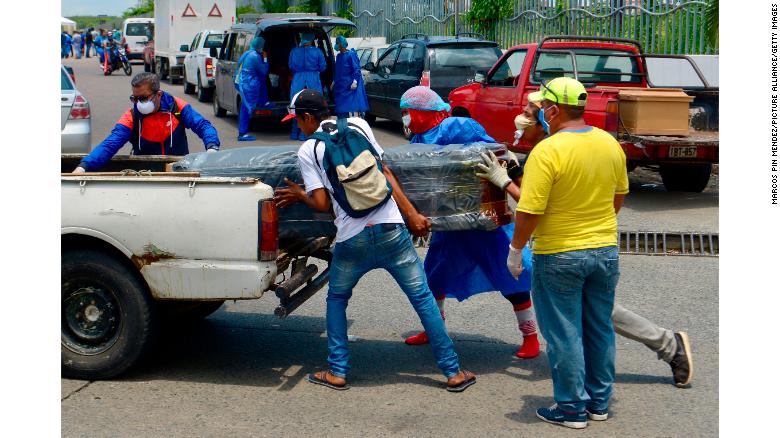
Men with protective suits load a coffin into a car in front of a Guayaquil hospital.
Guayaquil's
mayor Cynthia Viteri has desperately begged for help from the national
government in a video posted to her Twitter account last week. "What is
happening in the country's public health system? They are not taking
away the dead from houses, they're leaving them on the sidewalks,
they're falling in front of hospitals. No one wants to pick them up,"
she said, adding later, "we need to know the causes of why people are
dying in their homes."

"What
happens with our sick too?" she adds. "The families roam throughout the
city knocking on doors so they can be taken care of or that a public
hospital receives them where there are no more beds and they close the
door and leave them outside."
With
hospitals beyond capacity, some people are dying as they wait for
medical care. One Guayaquil woman died in a wheelchair at a hospital
while waiting to be seen in an emergency room. According to a hospital
source who asked not to be identified, there were no beds available and
her body was left out for almost four hours before it was taken away.
The cause of death has not been determined.
As
of Friday, Ecuador's National Service of Risk and Emergency Management
Department reports 3,368 confirmed coronavirus cases and 145 fatalities
nationwide, of which 102 are registered deaths in Guayas province, where
Guayaquil is located. But some citizens are concerned that confirmed
positive cases of infection are higher than what is being reported by
the Ecuadorian government, and they are demanding action, something
happening in other countries too as delays and lack of testing cause
frustrations.

Relatives wait outside of a hospital for information on family members infected with Covid-19 in Guayaquil on April 1.
President
Lenin Moreno during an address to the nation Thursday called for
transparency at all levels of government regarding the numbers caused by
the crisis. "It's important to tell the truth," Moreno said, adding
that in "both the number of cases and deaths, the records fall short."
Wated, the task force chief, has said that experts expect between 2,500 and 3,500 deaths in the coming months in Guayas alone.
Several
containers have arrived in Guayaquil to serve as temporary morgues to
accommodate the influx of bodies, and authorities say they plan to
create space for "dignified burials."
But
for now, some of the living in Guayaquil remain trapped in a nightmare,
with no way to mourn their loved ones, not even through a proper
burial.